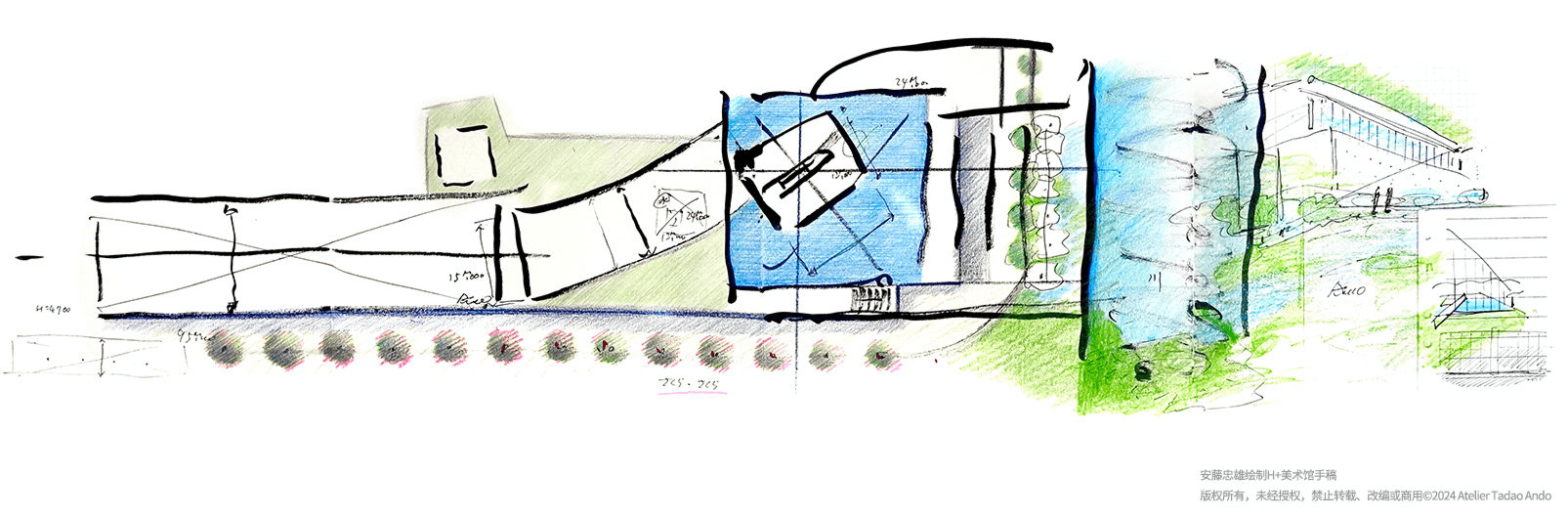
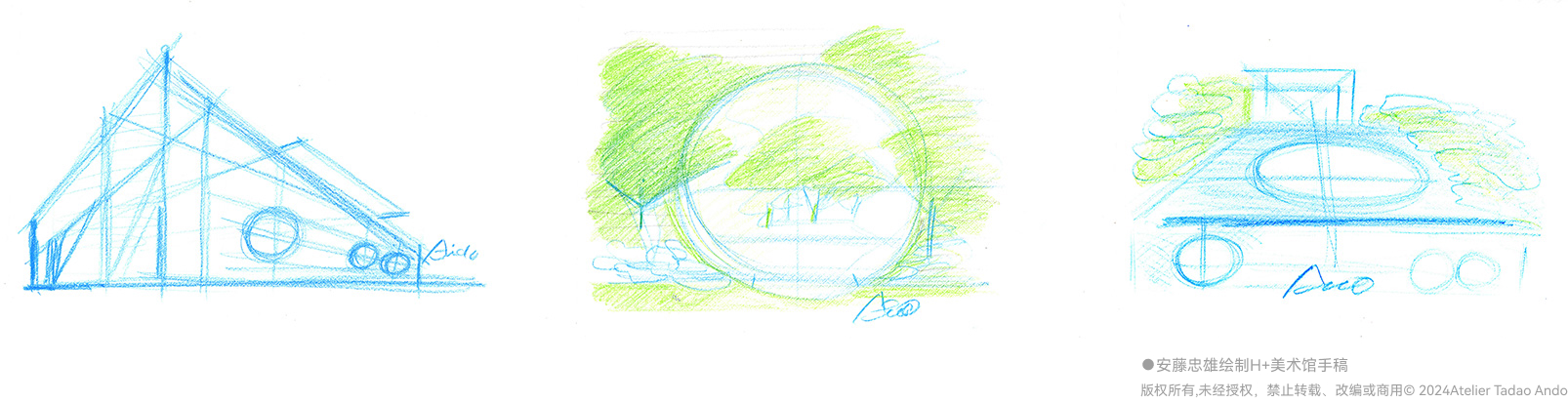
苏州是一座拥有2500多年历史的城市,至今仍持续向世人传递着深远的文化影响。运河与园林,作为描绘苏州不可或缺的元素,共同塑造了这座城市极具辨识度的景观与文化。即使从世界范围来看,苏州也是一座历史性与现代性共存的、极为珍贵而独特的城市。对H+美术馆的设计而言,面对像苏州这样具有鲜明个性的城市,如何回应其历史与文化,成为设计的关键主题。因此,安藤忠雄的设计目的是与城市真诚对话,创造出能够促进城市文化发展的新地标建筑。
受限于地块形状与高度控制,建筑整体呈现出阶梯状,为妙转化了这一限制,建筑师将整座建筑构想为了一座"立体园林"。立体园林随着外部形体呈现阶梯状的形态,可以产生各种具有场所性和有着不同视角的空间。而内部空间则强调回游性,即使在有限的场地内却有着宽敞的感受。
在有着不同标高的三层平台上,设计了"屋顶花园"和"水之露台"。"屋顶花园"呼应了苏州传统园林的精神,"水之露台"则展现出了与上塘河之间的关联性。两处空间共同构成了有着抽象形态的现代庭园,即可以承载各种各样的活动,也可以用于展示雕塑等作品。在这样的立体园林中,人们可随心漫步,欣赏不同的风景,或休憩,或聚集。我们期待这里可以成为激发出到访者创造性与好奇心的场所。
Suzhou carries more than 2,500 years of history and continues projecting profound cultural influence. Canals and gardens in Suzhou are the defining features of the city, forming its stunning scenery and unique cultural identity. Even on a global scale, Suzhou is an exceptionally precious city where history and modernity coexist. Designing H+ Art Museum meant addressing a key question: how to respond to a city with such distinct cultural character and historical heritage. Indeed, Tadao Ando’s approach was to engage sincerely with the urban context, creating a new landmark that could contribute to the city’s cultural heritage.
Due to the constraints of the shape and height of the plot, the architect conceived the entire building as a “Vertical Garden” with a terraced form. Following the shape of the building, it created various spaces of distinct characters and visual experience. For the interior, the design emphasizes circulation and wandering, generating a sense of spaciousness despite the compact site.
Across three platforms at different levels sit the “Roof Garden” and “Water Patio.” The “Roof Garden” recalls the spirit of traditional Suzhou gardens, while the “Water Patio” establishes a visual connection to Shangtang River. Together they form an abstract contemporary garden capable of hosting diverse activities and displaying sculpture. Within this layered garden, visitors can wander freely, take in changing views, leisure, or gathering. We hope it becomes a place that sparks creativity and curiosity.